Why a leash is so important on a SUP
Views on leashes have been changing in recent times. The mantra used to be – always wear a leash. This then evolved to ‘always wear a leash that is appropriate to the conditions’. We have now further revised that advice.
If becoming separated from your board is a bad outcome, then a leash is a vital component of SUP safety. Without a leash, a rider can easily become separated from their board should they fall off. The very act of falling off a board tends to propel the board away from the rider. In winds of more than a few knots, the board can be blown away faster than a rider can swim after it, especially if they are trying to hold on to their paddle (the natural instinct), and/or wearing a PFD, which inhibits fast swimming.
However, deciding whether becoming separated from your board is a bad outcome is a risk assessment that only you can make. If you close to shore, or in shallow water, or paddling along a canal or narrow river where you are never more than a few metres from the nearest bank, then the consquences of losing your board are not life threatening. In these environments you may choose not to wear a leash. In the fast-moving water environment (class 1 white water and above on rivers), an increasing number of paddlers are now choosing not to wear a leash.
Whereas if you are paddling further from shore, or in the surf, or you are a weak/non swimmer, then losing your board is potentially a very bad outcome, and a leash should always be worn. Especially in windy conditions, which greatly increases the risk of losing your board. A rider separated from their board is extremely vulnerable, especially when any significant distance offshore. A person in the water is hard to spot (especially in rough seas), and will lose body heat quickly if the water is cold.
Unfortunately, there is no one perfect leash for all conditions. This is why our advice about wearing leashes has evolved. A number of different styles of leash exist, and each is appropriate to a certain set of conditions – but if used in the wrong conditions, can cease to be a safety aid and become highly dangerous. (For a while it appeared that a quick-release leash worn around the waist was the best option, but the evidence that these are actually nowhere near fail-safe is becoming increasingly apparent.)
To really reinforce the point about why we wear a leash in windy conditions, check out the youtube clip below. It shows a person falling off while paddling in windy conditions without a leash – and pretty much instantly they’ve lost their board because it blows away much faster than they can swim. But then, to compound the problem, a friend on another paddleboard catches up with the wayward board, and attempts to take it under tow using their own leash. But she falls off, and is suddenly in grave danger of losing her board too.
This video was taken from an article in Men’s Journal about the dangers of paddleboarding without a leash
It is impossible to estimate how many rescue call-outs have been prevented and lives been saved by the wearing of leashes, as potentially any wipe-out could have resulted in the rider being separated from their board and getting into trouble, if a leash had not been worn! However, there is no doubt that a number of paddleboard fatalities worldwide (and a vastly greater number of rescue callouts) have been due to no leash being worn. The huge safety positives in leash-wearing are recognised throughout the industry worldwide, and the LEASHES SAVE LIVES campaign is now supported by many brands (see right). The Human Powered Watercraft Association in USA have this poster campaign advocating the use of leashes as the #1 safety item in paddleboarding. As they say: DO NOT DEPEND ON A PFD! WEAR A LEASH!
Another practical, if slightly morbid, advantage of leashes is that a paddleboarder struck down by sudden trauma (heart attack, stroke, seizure etc.) while paddleboarding, remains attached to their board and thus much easier to find. (There have been several instances of this worldwide, and it’s statistically inevitable that there will be more, given the sport’s appeal to, and suitability for, the older demographic).
It is also particularly important that a leash is worn when paddleboarding in surf. A SUP board separated from its rider becomes a dangerous projectile – being (generally) higher volume and wider than surfboards they tend to be picked up and propelled forward by the wave, and can cause harm to other water users.
Different types of leashes
The straight leash (ankle style)
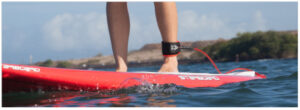
Description: A straight leash that attaches to the rider via a velcro-fastened cuff around the ankle.
Advantages: By far the most common form of leash in circulation. Low cost and very easy maintenance, as it can easily be inspected for damage. The only truly safe style of leash to wear in the surf to avoid recoil or whiplash injuries, and also because the rider’s head/torso needs to be as far away from the board as possible when board and rider are being ‘rinsed’ in a surf wipe-out (as opposed to leashes that attach to the calf or back).
Disadvantages: Can dangle in the water behind the board, creating a risk of catching on debris or obstacles in or under the water. Requires the rider being able to reach right down to their ankle in order to detach it, thus not suitable for any situation where a quick release under pressure may be required, such as when paddling in strong tidal flows or rivers.
Best suited to: Surf. Any water with minimal current (lakes, open sea, harbours, etc.), and low/no kelp, weed or obstacles that could catch on the leash.
Less suited to: Water with kelp or obstacles that could catch on the leash
NOT suited to: Any type of leash that attaches to the calf or ankle should NEVER be worn in fast-flowing water (rivers, white water, harbour mouths with strong currents etc.), due to the risk of the leash being caught on an obstacle and the rider not able to release their leash due to the strength of the current. If you find yourself in this environment while wearing an ankle leash, don’t stress, just take it off, and paddle on your knees until you are out of the hazardous area.
The straight leash (calf style)
Description: A straight leash that attaches to the rider via a velcro-fastened cuff around the calf, just below the knee.
Advantages: Low cost, very easy maintenance (i.e. can easily be inspected for damage). Assuming the right length of leash is used, it does not dangle in the water so much as the ankle leash, thus less prone to catching kelp/weed/obstacles, or getting caught up in the paddle.
Disadvantages: Still requires the rider being able to reach their calf in order to detach it, thus not suited to fast-flowing water conditions.
Best suited to: Any water with minimal current (lakes, open sea, harbours, etc.), and low/no kelp, weed or obstacles that could catch on the leash.
Less suited to: Surf – sharp whiplash-style tensioning can damage the knee.
NOT suited to: Any type of leash that attaches to the calf or ankle should NEVER be worn in fast-flowing water (rivers, white water, harbour mouths with strong currents etc.), due to the risk of the leash being caught on an obstacle and the rider not able to release their leash due to the strength of the current.
The coiled leash
Description: A coiled leash that attaches to the rider via a velcro-fastened cuff around the ankle or calf.
Advantages: Due to being shorter, this type of leash does not dangle in the water at all.
Disadvantages: Much less easy to inspect for damage, can twist and tangle (“telephone cord style”) after repeated stretches, can cause the board to spring back at the rider after a wipe-out.
Best suited to: Any water with low-moderate current (1-2 knots), particularly if the water contains kelp/obstacles that the leash could snag on.
NOT suited to: Any type of leash that attaches to the calf or ankle should NEVER be worn in fast-flowing water (rivers, white water, harbour mouths with strong currents etc.), due to the risk of the leash being caught on an obstacle and the rider not able to release their leash due to the strength of the current.
ALSO Not suited to: Surf conditions, as there is a strong risk of ‘bounce-back’ where the leash recoils and springs the board back at the rider after a wipe-out.
The quick-release leash
Description: A leash that attaches to a quick-release strap around the rider’s waist (sometimes an integral component of their PFD).
Advantages: The leash can be released, even when under extreme tension, via a quick-release pull toggle or tag situated at the front of the rider, usually at belly height.
Disadvantages: More expensive, not suitable for surf. Awkward if you are already wearing a beltpack PFD around your waist (important not to get the two tangled!). It is important to understand also that these leashes are NOT failsafe. There have been many recorded instances of users not being able to release them. As with any item of safety equipment, you really need to practice using it. Learn which hand to use (they’re all asymmetric), and assume that in an emergency situation, the belt will have pulled around so that the quick release handle is not where you are expecting it to be.
Best suited to: White water, rivers, any zones of strong current.
Less suited to: Beginners or anyone falling off regularly, as it’s quite easy to get tangled up in the leash, or get it wrapped around the board.
Racing leashes
Leashes with a coil and then a webbing/buckle component to allow the leash to be adjusted to exactly the right length. They have the same general advantages, disadvantages and danger zones as coiled leashes.
Multifunction leashes
A relatively new class of leash designed to offer the complete all-round solution, where the rider has both an ankle and waist-belt attachment, and can clip the leash into whichever is appropriate for the conditions. Still very much in the early stages of development and currently very expensive, and still requires a high level of user awareness (i.e. understanding of how and when to change modes etc.), but definitely offering a good option for the future.
So, which leash should you choose? Here is an excerpt from our free safety equipment course, presented by NZ SUP Safety Officer Bill Dawes. To watch the whole course, which goes into fine detail about how to ensure you have all the correct safety equipment for your paddleboarding, click here.